Overall Regional Statistics
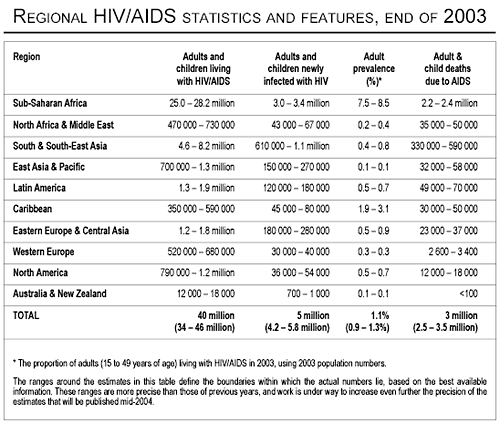
:: Sub- Sahara Africa
In 2003, 26.6 million people were living with HIV, including
3.2 million who became infected in the past 12 months. AIDS
killed approximately 2.3 million people in the same year. This
made the region by far the worst-affected by the HIV/AIDS
epidemic. Women are more likely to be infected than men.
In South Africa , the average rate of HIV
prevalence in pregnant women attending antenatal clinics was
about 25 percent. It is estimated that 5.3 million South
Africans were living with HIV at the end of 2002. Because it
is a relatively recent epidemic, and given current trends,
AIDS deaths will continue to increase rapidly over the next
five years.
In four neighboring countries, Botswana, Lesotho,
Namibia and Swaziland, HIV
prevalence has reached extremely high levels without signs of
leveling off. Infection rates in Botswana and
Swaziland are around 39 percent. HIV
prevalence in antenatal sites in Namibia rose
to over 23 percent in 2002. Lesotho’s most
recent data shows median HIV prevalence among antenatal clinic
attendees climbing to 30 percent. There are signs that the
epidemic is leveling off in Zambia .
Uganda remains a relative bright spot. HIV
prevalence fell to 8 percent in Kampala in 2002.
In West Africa, Cote d’Ivoire has the
highest HIV prevalence with more than one in 10 pregnant women
having HIV infections in some of the country’s regions.
Across most of Sub-Saharan Africa, HIV prevalence among
pregnant women visiting antenatal clinics has been roughly
level for several years. But this is because AIDS has killed
as many people as have been infected with HIV each year. This
hides a persistently high number of annual, new HIV
infections.
:: Latin America & the Caribbean
More than 2 million people are now living with HIV in Latin
America and the Caribbean, including the estimated 200,000
that contracted HIV in the past year. At least 100,000 people
died of AIDS in the same period – the highest regional death
toll after Sub-Saharan Africa.
National HIV prevalence rates are above 1 percent in 12
countries in the Caribbean Basin. The most recent national
estimates showed HIV prevalence among pregnant women reaching
or exceeding 2 percent in six of them; the Bahamas,
Belize, the Dominican Republic, Guyana, Haiti
and Trinidad and Tobago .
Brazil remains the country with the most
HIV infected people. A strong prevention effort and an active
program to treat people with HIV, has helped keep the HIV
prevalence of pregnant women attending antenatal clinics below
1 percent.
Two of the most serious epidemics in the region are on
Hispaniola Island – in Haiti and the
Dominican Republic . AIDS claims 30,000 lives a year
and the national HIV prevalence rate is 5–6 percent.
Prevention efforts appear to have stabilized HIV infection in
the Dominican Republic. Having climbed to 3 percent in 1995,
it has fallen to less than 1 percent in pregnant women aged
15-24.
In Central America, national HIV prevalence is around 1
percent in Guatemala, Honduras and
Panama .
The mode of HIV transmission tends to vary in different
parts of the region. In the bulk of the South American
countries, HIV is being transmitted chiefly through injecting
drug use and sex between men. In Central America, most HIV
infections appear to be occurring through sexual transmission
(both heterosexual and between men) and in the Caribbean
through heterosexual transmission.
:: Eastern Europe and Central Asia
The AIDS epidemic in Eastern Europe and Central Asia shows no
sign of abating. About 230,000 people were infected with HIV
in 2003, bringing the total number of people living with the
virus to 1.5 million. AIDS claimed an estimated 30,000 lives
in the past year.
The Russian Federation had acumulative
229,000 people who had been diagnosed with HIV by the end of
2002. Ukraine (cumulative total of 52,000)
and the Baltic States (Estonia,
Latvia and Lithuania) also have rising AIDS problems.
HIV also continues to spread in Belarus, Moldova
and Kazakhstan. More recent epidemics are
emerging in Kyrgyzstan and Uzbekistan
.
Driving these epidemics is widespread
risky behavior – injecting drug use and unsafe sex – among
young people. Injecting drug use has increased sharply in the
past few years and condom use remains low. Prevention efforts
targeting risky behaviors can halt these epidemics.
:: East Asia and the Pacific
While national HIV prevalence rates remain under 1 percent in
the majority of the region’s countries, several provinces and
states have series epidemics. There are increasing warning
signs that series HIV outbreaks threaten several countries.
Injecting drug use and sex work are so pervasive in some areas
that even countries with currently low infection levels could
see sudden surges in the epidemic.
China’s low national HIV prevalence rate
obscures the fact that serious, concentrated epidemics are
underway in certain regions such as Yunnan, Xinjiang, Guangxi,
Sichuan, Henan and Guangdong. In parts of the country, for
example, high rates of HIV prevalence have been found among
injecting drug users.
Three Asian countries, Cambodia, Myanmar
and Thailand , have already contended with
serious nationwide epidemics. But Cambodia has stabilized its
epidemic at 3 percent since 1997 and Thailand’s 100 percent
condom program brought its rampant epidemic to heel in the
1990s, with national HIV prevalence hovering at about 2
percent in 2002.
Vietnam ’s prevalence rate remains under 1
percent. But it faces the possibility of a serious epidemic.
In 2002, Sentinel surveillance found more than 20 percent of
injecting drug users in most provinces were HIV positive and
there are signs that sex workers are also becoming infected.
HIV prevalence rates of 11 percent and 24 percent have been
detected among sex workers in Can Tho and Ho Chi Minh City
respectively. Infection rates among sex workers stand at 15
percent in Hanoi and 8 percent in Hai Phong.
In Indonesia , despite an increase in
condom social marketing and AIDS-awareness campaigns, condom
usage remains low, even in commercial sex. Estimates suggest
that fewer than 10 percent of the seven to 10 million men who
frequent sex workers use condoms consistently. But injecting
drug users are the major driver of Indonesia’s epidemic. Over
90 percent of injecting drug users have been found to use
unclean injecting equipment in three major cities.
Papua New Guinea has the highest reported
rate of HIV infection in the Pacific with an estimated
prevalence rate of almost 1 percent among pregnant women
attending antenatal clinics in Port Moresby.
:: South Asia
South Asia’s epidemic continues to be dominated by the
enormous number of people infected with HIV in India. However
the epidemic could quickly explode in other parts of the
region because of a high incidence of risky behavior.
India had between 3.82 and 4.58 million
people infected with HIV by the end of 2002. In the past year,
at least 300,000 acquired HIV and serious epidemics are now
underway in several states – including Maharashtra and Tamil
Nadu where HIV prevalence of over 50 percent has been found in
sex workers in some cities and in Manipur where HIV prevalence
among injecting drug users ranges between 60 percent and 75
percent.
In Bangladesh and Nepal ,
national HIV prevalence has remained under 1 percent but risky
behavior in parts of the population is so extensive that it
could spark a wider epidemic.
In Pakistan, the few available HIV
surveillance studies suggests HIV prevalence among injecting
drug users and sex workers has been low. But there is evidence
that injecting drug use is increasing and low knowledge about
HIV transmission creates the potential for sharp a increase in
the epidemic.
:: Middle East and North Africa
Latest estimates indicate that 55,000 people acquired HIV
infection in the past year, bringing to 600,000 the total
number of people living with HIV/AIDS in the Middle East and
North Africa. AIDS killed a further 45,000 people in 2003.
There is the potential for a considerable rise in the number
of HIV infections in the region.
Sudan is the most seriously affected
country in the region with a national adult HIV prevalence of
more than 2 percent. Conflict is hampering both the
surveillance of the epidemic and the country’s ability to
mount an effective response. The epidemic is mainly
heterosexual and more concentrated in the south.
The epidemic threatens to expand along diverse routes
including through blood transfusions and blood collection.
Also of concern is the rise in HIV infections among injecting
drug users, particularly in Bahrain, Libya
and Iran. This form of transmission is also
linked to infections in Algeria, Egypt, Kuwait,
Morocco, Oman and Tunisia and
Iran . Sex workers and men who have sex with
men are also highly vulnerable in this region.
Effective prevention is needed speedily across the regions,
designed to target both vulnerable groups and groups that
could be drawn into the next phase of the epidemic. But at
present, even basic activities such as condom promotion are
largely absent in the region.
But there are some encouraging exceptions to what appears
to be a general pattern of official denial in the region.
Algeria, Lebanon, Iran and Morocco
are developing more substantial prevention programs and some
countries (Iran and Libya )
appear more willing to acknowledge and tackle epidemics
associated with injecting drug use.
:: High-Income Countries
The total number of people living with HIV continues to rise
in high-income countries, largely due to widespread access to
antiretroviral treatment. It is estimated that 1.6 million
people are living with HIV in these countries – a figure that
includes the 80,000 newly infected in 2003. AIDS claimed about
18,000 lives in the past year.
In the United States , around half of the
40,000 new infections annually are occurring among
African-Americans. An increasing number of women are being
infected by their male partners who have sex with men or use
injecting drugs. AIDS is now the leading cause of death for
African-American women aged 25-34.
In Germany, Greece and the
Netherlands, sex between men is an important aspect
of transmission. In the US (in 2002) and
Australia (in 2001) it accounted for 42
percent and 86 percent of new HIV diagnoses respectively.
Of concern is a resurgence of other sexually transmitted
diseases in Australia, Japan, Western Europe
and the US , which points to an increase in
high-risk behavior, including among men who have sex with men.
Japan is seeing a steady increase in the
number of reported HIV infections. The number of new HIV cases
reported annually has doubled since the 1990s to more than 600
in 2001 and 2002.
|
