| Sundarbans
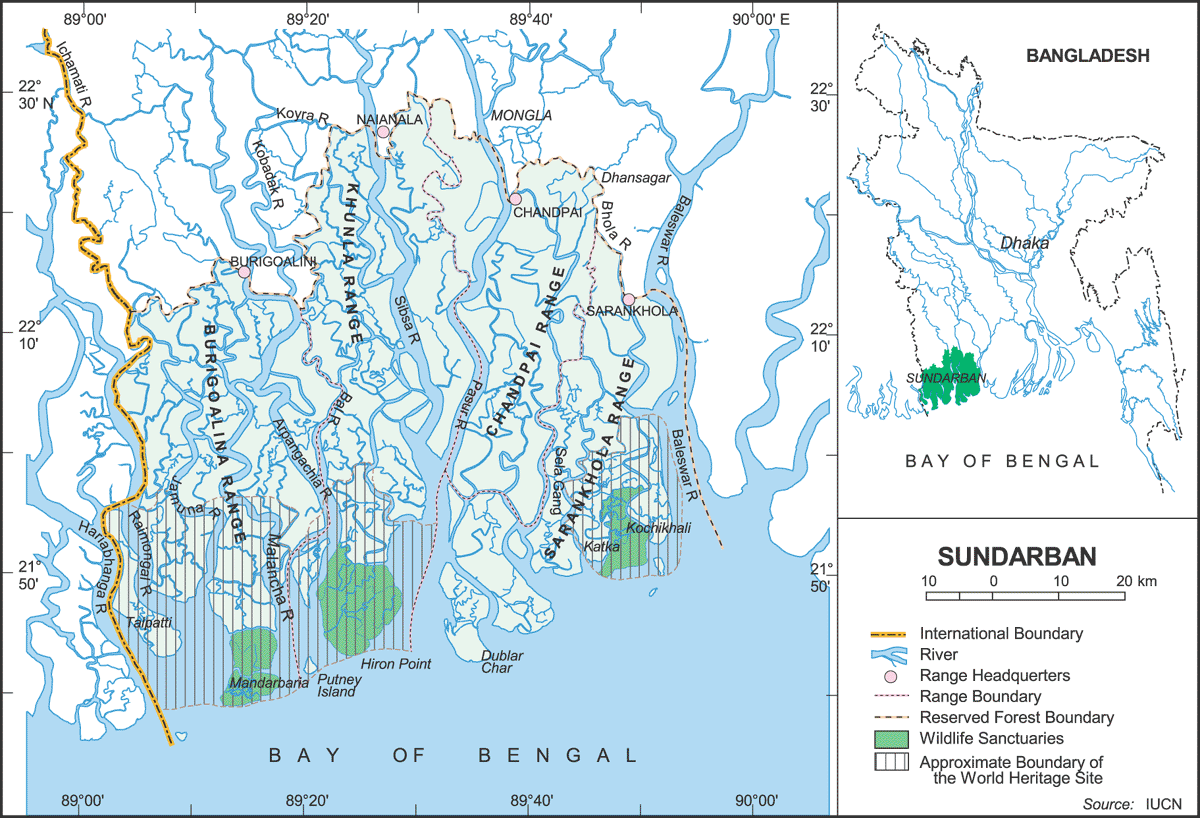
Sundarbans, The largest
single block of tidal halophytic mangrove
forest in the world, located in the southern
part of Bangladesh. It lies on the Ganges-Brahmaputra
Delta at the point where it merges with
the bay of bengal. The forest lies a little
south to the Tropic of Cancer between
the latitudes 21º30´N and 22º30´N,
and longitudes 89º00´E and
89º55´E. With its array of
trees and wildlife the forest is a showpiece
of natural history. It is also a centre
of economic activities, such as extraction
of timber, fishing and collection of honey.
The forest consists of about 200 islands,
separated by about 400 interconnected
tidal rivers, creeks and canals.
The Sundarbans was originally
measured (about 200 years ago) to be of
about 16,700 sq km. Now it has dwindled
to about 1/3 of the original size. Because
of the partition of India, Bangladesh
received about 2/3 of the forest; the
rest is on the Indian side. It is now
estimated to be about 4,110 sq km, of
which about 1,700 sq km is occupied by
waterbodies. The forest lies under two
forest divisions, and four administrative
ranges viz Chandpai, Sarankhola, Khulna
and Burigoalini and has 16 forest stations.
It is further divided into 55 compartments
and 9 blocks. The Sundarbans was declared
as a Reserve Forest in 1875. About 32,400
hectares of the Sundarbans have been declared
as three wildlife sanctuaries, and came
under the UNESCO World Heritage Site in
1999. These wildlife sanctuaries were
established in 1977 under the Bangladesh
Wildlife (Preservation) (Amendment) Act,
1974. These are Sundarbans West (9,069
ha), Sundarbans South (17,878 ha), and
Sundarbans East (5,439 ha).
The Bangla word ban means
forest, and the name Sundarban was coined
either from the forests of Sundari tree
ie Sundari-ban, or from the forests of
the samudra (sea) ie, Samudra-ban, or
from its association with the primitive
tribe Chandra-bandhe which was corrupted
into Sundarban. The generally accepted
explanation, however, is its derivation
from the sundari tree, the most common
tree in these forests.
Geology The tract of
the Sundarbans is of recent origin, raised
by the deposition of sediments formed
due to soil erosion in the Himalayas.
The process has been accelerated by tides
from the sea face. The substratum consists
mainly of Quaternary Era sediments, sand
and silt mixed with marine salt deposits
and clay. Geologists have detected a southeastern
slope and tilting of the Bengal basin
during the Tertiary. Because of neo-tectonic
movements during the 10th-12th century
AD, the Bengal Basin titled eastward.
Evidence from borehole studies indicate
that while the westernside of the Sundarbans
is relatively stable, the southeastern
corner is an active sedimentary area and
is subsiding.
Soil Soils of the Sundarbans
mangrove forest differ from other inland
soils in that they are subjected to the
effects of salinity and waterlogging,
which naturally affect the vegetation.
In places soils are semi-solid and poorly
consolidated. The pH ranges widely from
5.3 to 8.0. Although the Sundarbans soil
is in general medium textured, sandy loam,
silt loam or clay loam, the grain size
distribution is highly variable. Silt
loam is dominant textural class. Sodium
and calcium contents of the soil vary
from 5.7 to 29.8 meq/100g dry soil and
are generally low in the eastern region
and higher towards the west. The available
potassium content of the soil is low,
0.3-1.3 meq/100g dry soil. Organic matter
content varies between 4% and 10% in dry
soil. Soil salinity increases from east
(slight to moderate) to west (highly saline),
but the salinity is not uniform from north
to south throughout the forest.
Climate Since the forest
is located on the south of the Tropic
of Cancer and bounded by the northern
limits of the Bay of Bengal, it is classified
as tropical moist forest. The temperatures
in the Sundarbans are fairly equable than
those of the adjacent land areas. The
average annual maximum and minimum temperatures
vary between 30º and 21ºC. High
temperatures occur from mid-March to mid-June
and low in December and January. The mean
maximum temperature for the hottest months
has been recorded as 32.4ºC at Patuakhali,
in the east of the Sundarbans.
The mean annual relative
humidity varies from 70% at Satkhira to
80% at Patuakhali. Humidity is highest
in June-October and lowest in February.
Annual rainfall in the Sundarbans is in
the range of 1640-2000 mm, rainfall increases
from west to the east. Most rainfall occurs
during the monsoon from May to October.
Frequent and heavy showers occur from
mid-June to mid-September. Often storm
accompanied by tidal waves result widespread
inundation and cause damage to vegetation
and animal life.
Vegetation The vegetation
is largely of mangrove type and encompasses
a variety of plants including trees, shrubs,
grasses, epiphytes, and lianas. Being
mostly evergreen, they possess more or
less similar physiological and structural
adaptations. Most trees have pneumatophores
for aerial respiration. The prominent
species is Sundari (Heritiera fomes) and
Gewa (Excoecaria agallocha). Prain (1903)
recorded 334 species under 245 genera.
Of these 17 are pteridophytes, 87 monocotyledons
and the rest are dicotyledons. The plant
species include 35 legumes, 29 grasses,
19 sedges, and 18 euphorbias. Of the 50
true mangrove plant species recorded,
the Sundarbans alone contain 35. Almost
all mangrove plant species are evergreen,
dwarf, shrubby or tall trees, and grow
gregariously without leaving any space
on the floor.
In the Sundarbans the
saltwater forest is situated in the south-western
part where Gewa (E. agallocha), Goran
(Ceriops decandra), Keora (Sonneratia
apetala), Ora (S. caseolaris), Passur
(Xylocarpus mekongensis), Dhundul (X.
granatum), Bain (Avicennia alba, A. marina,
A. officinales), and other rhizophores,
and Hantal (Phoenix pelludosa) dominate.
The typical mangrove species dominate
the central part of the forest. The moderate
saltwater forest covers most of the southern
parts of Khulna and Bagerhat districts
where Sundari is the dominant species.
There is a thick mat
of the nipa palm or 'Golpata' (Nipa fruticans)
by the side of almost all the canals.
The moderately freshwater zone results
from the large amount of water, which
flows down the Passur, Haringhata and
Burisher, maintaining the surface water
at a lower level of salinity
The Sundarbans shows
some distinct phyto-succession, where
the newly formed lands are occupied by
some pioneer species viz Leersia hexandra,
wild rice (Potresia species), followed
by Avicennia, Sonneratia and Aegiceras.
The secondary succession occurs due to
Ceriops, Excoecaria, Bruguiera, Heritiera,
Xylocarpus and Rhizophora. Tiger fern
(Achrostichum aureum) mostly covers the
ground floor, which is common in saltwater
and moderately saltwater zones. Tigers
use these bushes to camouflage themselves.
Fauna The Sundarbans
hosts a large variety of animals. It is
the last stronghold of the bengal tiger
(Panthera tigris). Within the forest habitats
there are about 50 species of mammals,
about 320 species of inland and migratory
birds, about 50 species of reptiles, 8
species of amphibians, and about 400 species
of fish.
Besides the spectacular
Royal Bengal Tiger, the other notable
mammalian fauna are Spotted deer (Cervus
axis), Barking deer (Muntiacus muntjak),
Rhesus macaque (Macaca mulatta), Jungle
cat (Felis chaus), Leopard cat (Prionailurus
bengalensis), the Indian porcupine (Hystrix
indica), Otter (Lutra perspicillata),
and wild boar (Sus scrofa). deer and wild
boar constitute the main prey for the
tiger. Some species including the Bengal
tiger are endangered.
The ecological diversity
of the Sundarbans supports a large variety
of birds. Among the total number of species
recorded, most are resident. Over 50 species
are known to be migratory and are mostly
represented by the waterfowls. The egrets,
storks, herons, bitterns, sandpipers,
curlew, and numerous other waders are
seen along the muddy banks. There are
many species of gulls and terns, especially
along the seacoast and the larger waterways.
Accipitridae (kites, eagles, vulture,
harrier etc) is represented by about 22
species. Nine species of kingfishers are
available in the forest. The rich avifaunas
of the forest include species of woodpeckers,
barbets, owls, bee-eaters, bulbul, shrikes,
drongos, starlings, mynas, babblers, thrush,
oriole, flycatchers, and many others.
Of about 50 species of
reptiles the largest member in the Sundarbans
is the Estuarine crocodile (Crocodylus
porosus), some of which may attain a length
of about seven metres. Although once they
were abundant in this mangrove habitat,
their total number is now estimated to
be around 250. Species of lizards, including
the Monitor Lizards Varanus, turtles,
and snakes are well-represented. Among
the snakes, the King Cobra (Ophiophagus
hannah), Russell's Viper (Vipera russellii),
Rock python (Python molurus), Banded Krait
(Bungarus fasciatus) and several species
of sea snakes are notable.
Only eight species of
amphibians have been reported from the
Sundarbans. The green frog (Euphlyctis
hexadactylus) is mostly observed in Chandpai
area of the mangrove forest. The other
forest amphibians include the Skipper
frog (E. cyanophlyctis), Cricket frog
(Limnonectes limnocharis), Tree frog (Polypedates
maculatus), and the common toad.
The Sundarbans suports
nearly 400 species of fishes in its varied
aquatic habitats; these include both the
pelagic and demersal fishes. Many species
use these habitats as nursery grounds.
No aquaculture or fish farming is allowed
in the Sundarbans. The Forest Department
controls the fish catch from the area.
Among the invertebrates
some molluscs and crustaceans constitute
important fisheries resources. About 20
species of shrimps, 8 species of lobsters,
7 species of crabs, several species of
gastropods, and 6 species of pelecypods
have been reported from the Sundarbans.
Among the shrimps Penaeus monodon and
Metapenaeus monoceros and the mud crab
Scylla serrata are commercially important.
Insects are varied, the most important
being the honeybee Apis dorsata. Locally
known as 'Mouals', the professional bee
collectors gather honey for three to four
months during the flowering season taking
permission from the Forest Department.
The forest is very rich in its spider
fauna (Araneae). Nearly 300 species under
22 families have been recorded from the
mangrove forest habitats.
Economic value, tourism
and forest dwellers The most important
value of the Sundarbans lies in its protective
role. It helps hold coastlines, reclaim
coastal lands, and settle the silt carried
by the rivers. The estuary is a good breeding
centre for many fishes. Several plant-based
industries have been developed here. The
most important ones are the newsprint
and hardboard mills in Khulna. The raw
material for the former is gewa and for
the latter sundari. Other important plant-based
industries are match factories and boat
building. The forest is a good source
of fuel, tannins, thatching, wooden articles,
medicinal plants, and fodder. The forest
is also a major source of honey and bee
wax. Aegiceras corniculatum, Ceriops decandra,
Nipa species, Derris species, and Hibiscus
tiliaceous are the major honey plants.
Most frequently visited
sites in the Sundarbans include Katka,
Hiron Point (known commonly as Nilkamal),
Dublar Char and Tiger Point (Kachi Khali).
Katka attracts tourists for its landscape
and wildlife. There is a forest rest house
here and an observation tower. Hiron Point
also has a rest house and an observation
tower. Dublar Char is an island with a
beautiful beach. The other attraction
of the island is the fishing activities
that take place every year between mid-October
and mid-February. Fishermen from other
places of the country, especially from
Chittagong, assemble here during the period
to catch fish and dry them on the sunny
beach. The honey collectors go into the
forests during April-May.
Only a few people live permanently in
or around the Sundarbans. They include
the bawalis (collectors of golpata), mouals
(honey collectors) and woodcutters. Their
dwellings are usually at the edge of the
forest and the houses are built on platforms
supported on 3-5 m high poles of wood
or bamboo. Some people, especially the
bedyas (gypsy) live on boats.
Sundarbans forest regeneration
Natural regeneration refers to renewal
of a tree crop by natural means, as opposed
to artificial regeneration by means of
planting or sowing as done in mangrove
plantation. The mangrove of the Sundarbans
is dependent on natural regeneration for
its existence. Over the greater part of
the forest, seedling recruitment was sufficient
for replacement of the harvested trees.
The average number of seedlings appearing
per year was about 27,750/ha although
recruitment densities varied considerably
among different parts of the forests.
Heritiera fomes, Excoecaria agallocha
and other species together constituted
about 24, 54 and 22 percent of the recruits
(three months old seedlings), respectively.
Salinity of the area
apparently influences the regeneration
density which decreases with increasing
level of salinity. There is year to year
variation in recruitment. However, salinity
appears to have little influence on these
variations. Variation in seedling recruitment
among the three salinity zones seems to
be significant. Seedling recruitment for
H. fomes, E. agallocha, and other species
shows highly fluctuating values over the
years. Such fluctuation might be due to
the existence of periodicity in the seed
production of some species.
Source: Banglapedia,
National Encyclopedia of Bangladesh
Asiatic Society of Bangladesh
|