By environment correspondent Alex
Kirby
Some campaign groups are already
touting the climate conference in The Hague as "the last
chance to save the planet".
That is green hyperbole, and it
is dangerously misleading.
Conferences of this sort are mere
waystations on a long and winding road, and they alone will
neither save nor condemn any of us.
But the campaigners are right
about one thing: the conference cannot afford to be seen to
fail.
|
Highest CO2 emissions
|
USA - 22.4%
China 13.4%
Russia 7.1%
Japan 4.9%
India 3.8%
Germany 3.5%
|
|
Source: Environment
Agency, 1994
|
|
|
It is a rare opportunity to move
from talking about climate change to doing something practical
about it: deciding the workings of the Kyoto Protocol, the
international treaty on tackling the problem.
It has some tricky decisions to
take: how to channel cash and technology from rich to poor and
whether to compensate the oil producers are two obvious
sticking-points.
Then it must decide how to make
sure agreed cuts in greenhouse gases mean real reductions in
real pollution, not just paper cuts that leave the gases
billowing upwards unchecked.
And this unwieldy assembly of
about 160 countries will have to work out a system of
punishments for those who ignore the protocol's targets - or
else agree to leave them unpunished, which would probably spell
the treaty's end.
Unpromising beginnings
The auspices for agreement on
these and other problems are not high, because many of the
countries which have signed the protocol look set already to
fail to reach its pollution reduction targets.
|
Per capita emissions of
CO2
|
USA 5.5 tonones
Canada 4.3 tonnes
Russia 3.2 tonnes
Germany 2.9 tonnes
UK 2.6 tonnes
|
|
Source: Environment
Agency, 1994
|
|
|
The UK will probably do so, as will
Germany, but many of the other 38 industrialised countries
committed to cut greenhouse gas emissions (the Annex 1
countries, as they are called) are likely to fail.
The US will probably fail, too,
and if it does that will send an important signal, because the
Americans - officially, at least - remain highly ambiguous about
the entire Kyoto Protocol process.
They say they will not ratify it
until developing countries make "meaningful"
commitments - a stance which is likely to prove another
stumbling block at The Hague, unless lobbyists' reports of a
softening in Washington's position prove correct.
And until the protocol is
ratified (by at least 55 signatories of its parent treaty, the
UN Climate Change Convention, including developed countries
responsible for at least 55% of the carbon dioxide emitted in
1990), it will remain to all intents and purposes a dead letter.
Tiny dent in huge problem
But just suppose everyone makes
good progress towards achieving their targets, and suppose too
that the conference does manage to resolve all the thorny
problems it will face.
The delegates will leave The
Hague convinced they have won the day - and the world's warming
trend will have been slowed by the smallest fraction.
The brutal
truth is that the Kyoto Protocol is not going to make very much
difference to climate change anyway.
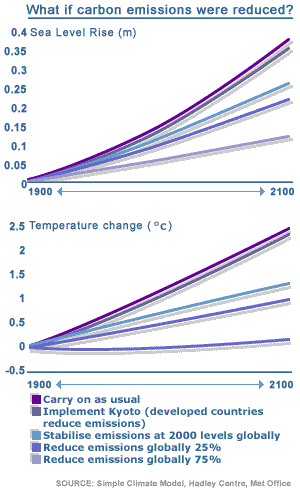
Click
here for infographic
Overall, it requires emission
cuts that will bring the 1990 levels of the six main greenhouse
gases down by 5.2% by 2012 at the latest.
Achieving that would reduce the
world's temperature by something like one-tenth of one degree
Celsius. Yet the scientists on the Intergovernmental Panel on
Climate Change agree that keeping global warming within
tolerable limits will require cuts of at least 60% in carbon
emissions before long.
Poweful message
At its very best, then, the Kyoto
Protocol can be no more than a first tentative step.
But it is an essential step,
always assuming that the IPCC scientists are right in their
conclusion that humanity's activities have "contributed
substantially to the observed warming over the last 50
years".
That is why the campaigners
insist it is vital that The Hague does not fail.
If it did, they say, it would be
a declaration that the world was not ready even to take that
first small step.
And a message of that sort might
well lead many countries to think there was little point in
taking climate change very seriously.
The momentum could start to drain
out of the process, the politicians would run out of steam.
The Hague will not be the last
chance to save the planet. But it could be the last gasp for the
Kyoto Protocol.