| Arsenic
Water Contamination: Local tech-whiz devises a simple way out
Naimul Haq
The Daily Star 4th June,2005
 A
Bangladeshi scientist has devised a simple, inexpensive but ingenious
technology to treat surface water for drinking that offers a cost-effective
substitute to the arsenic-contaminated water, widespread in the
country. The new technology demands a return to the tradition
of drinking surface water instead of groundwater, says Prof M
Fakhrul Islam, the inventor. A
Bangladeshi scientist has devised a simple, inexpensive but ingenious
technology to treat surface water for drinking that offers a cost-effective
substitute to the arsenic-contaminated water, widespread in the
country. The new technology demands a return to the tradition
of drinking surface water instead of groundwater, says Prof M
Fakhrul Islam, the inventor.
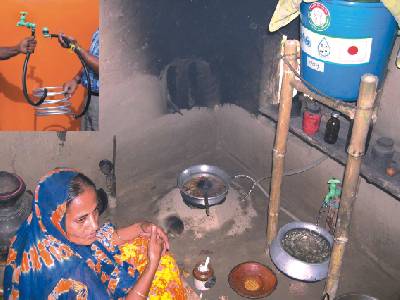
The devise, christened 'Chulli Water Purifier',
is made of a hollow aluminium coil and some plastic pipes. It
makes use of the heat generated by a clay oven (Chulli), common
in rural Bangladesh, during cooking to treat water. Over 650 households
have already adopted the technique and the Unicef has successfully
field-tested around 500 purifiers in the last couple of years,
says Fakhrul, a retired professor of applied chemistry and chemical
technology of the Rajshahi University.
The purification process involves passing surface
water through the hollow aluminium coil connected to a clay oven.
As water passes through the coil, its temperature rises to 70
to 80 degree Celsius, killing the pathogens that cause diarrhoea
and other water-borne diseases. The hot water is then collected
in a traditional earthen pitcher called Kolshi and used for drinking
when it cools down.
"The system is simple and inexpensive, and laboratory tests
have proved its efficacy. It also helps the poor villagers avoid
the extra cost needed to boil water, like the urban people do,"
the professor notes. A number of scientists agree that if the
new technology is promoted and put to extensive use, it may gradually
substitute the 'tube-well technology', which in the past two decades
has proved unsafe.
The Integrated Approach for Community Development (IACD), a local
non-government organisation that focuses on developing affordable
water and sanitation technologies, introduced the Chulli technology
last year, informs David B Nunley, representative of Wagtech International,
a UK-based organisation that supports such locally developed techniques.
Considering its affordability and prospects
of community acceptance, the Department of Public Health and Engineering
(DPHE) in association with the Unicef engaged the IACD to field-test
the Chulli technology in areas, where 90 to 100 percent tube-well
water is contaminated with arsenic above the acceptable level.
The rural poor cannot afford to buy fuel solely
to boil drinking water, says Nunley, so the Chulli technique offers
a perfect solution by using the heat of cooking ovens. According
to a study of the Bangladesh Council for Scientific and Industrial
Research (BCSIR), more than 80 percent of the heat produced by
rural ovens is wasted to the atmosphere. Only a small percentage
of that heat is needed to kill the bacteria in surface water.
The Chulli system uses simple gravity flow to pass water through
the coil. Water is poured into a 25-litre plastic bucket placed
on a three-foot high stand made of bamboo. The bucket contains
12kg sand and is connected to the input end of the aluminium coil
by a locally made connector or valve fitted at its bottom. The
sand filter frees the surface water of all organics, algae and
foreign matters before letting it pass through the coil.
Once the heat from the Chulli reaches the cooking
temperature, the plastic valve at the bottom of the bucket is
opened, releasing the water into the coil. The water is allowed
to run through the coil at the specific flow rate of 500ml per
minute. As it flows through the coil, it gathers heat until it
reaches the exit temperature of approximately 70-degree Celsius
and comes out at the other end of the coil through a plastic faucet.
"In view of the very high production rate
of bacteria-free water from ordinary surface water sources, the
Chulli technology has potentials of mass application in areas
where ground water is arsenic-contaminated but an abundant supply
of surface water exists," observes DPHE Superintending Engineer
Ihtishamul Huq.
"A major challenge for arsenic mitigation
has been to find an alternative water source, which is free of
germs and chemicals, can supply safe water all round the year,
is inexpensive and easy to operate, and is well accepted by consumers.
The Chulli purifier seems to meet all of these conditions,"
remarks Unicef Project Officer for Water and Environmental Sanitation
Rick Johnston. "It is inexpensive,
easy to operate, and has little or no recurring costs. It quickly
purifies surface water, generating more than enough microbiologically
safe water that a family needs a day," he says.
|
