|
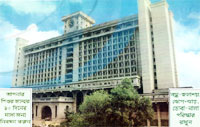 Dhaka Municipality was established on the 1st
August, 1864. Prior to the establishment of the Municipality, a
Committee of Improvement existed in the city as early as 1823. The
Committee consisted of three members was headed by Mr. Walters,
the then Collector of Dhaka. This Committee was replaced by
another Committee named "Dhaka Committee" in 1840. with wider
range of functions. This Committee too was appointed by the
Government rather than constituted under any law and, as such, had
no corporate entity of its own. Dhaka Municipality was established on the 1st
August, 1864. Prior to the establishment of the Municipality, a
Committee of Improvement existed in the city as early as 1823. The
Committee consisted of three members was headed by Mr. Walters,
the then Collector of Dhaka. This Committee was replaced by
another Committee named "Dhaka Committee" in 1840. with wider
range of functions. This Committee too was appointed by the
Government rather than constituted under any law and, as such, had
no corporate entity of its own.
District Municipal improvement (Act III B.C. of 1864) was
introduced in Dhaka from the 1st August, 1864.Through the
introduction of this Act the "Dhaka Municipal Committee" was
formed. The District Magistrate was ex-officio Chairman and such
persons as the Lieutenant-Governor would appoint, were the
Vice-Chairman. The Lt. Governor had power to appoint municipal
Commissioners from among the inhabitants and their number was not
to be less than seven. Five Commissioners constituted a quorum to
transact business at meeting. Mr. Skinner, the then District
Magistrate of Dhaka was the first ex-officio Chairman.
The Act of 1884 recognised for the first time the elective
principle in unambiguous term. The Chairman, the Vice-Chairman and
two thirds of the Commissioners were to be elected. The first
elected Chairman was Mr. Ananda Chandra Roy and the first elected
Vice-Chairman was Mr. Khawaja Amirullah. It may be noted that
municipal administration in Dhaka was, in point of the acceptance
of the elective principle, much ahead of the local self-government
in the Sub-continent as a whole.
The next significant milestone was the Bengal Municipal Act of
1922. This Act extended franchise to women also who had so far
been denied this right. The proportion of appointed commissioners
was reduced from one-third to one-fifth. Reservation of seats for
minority communities was provided for, the number of such seats
being in proportion to the number of such a community to the total
population of the municipality.
After the partition of India, Dhaka became the provincial capital
of the then East Pakistan in 1947. The Dhaka Municipal Committee
was superseded by the Govt. on the 19th of November, 1947. The
reason for supersession was attributed to the inefficiencies in
collection of taxes development activities etc. The term of
supersession was extended by annual orders on the score of
non-preparation of electoral rolls, until 1953. In December, 1953,
the elected Chairman took over his office and again in August,
1959, Municipality was superseded.
The Municipal Administration Ordinance of 1960 repealed all
previous municipal laws and provided that the chairmen would be an
official member appointed by and holding office during the
pleasure of the Govt. The commissioners elected one of their
members to be the Vice-Chairmen. The Government in 1960 divided
the city area into 25 Unions, which were later enhanced by 30
Unions in 1964. The Chairmen of the Union Councils were the
members of the Dhaka Municipality.
Dhaka became the capital of Bangladesh with the independence in
the year 1971. City area was divided into 50 wards and election of
Ward Commissioners was held in 1977 with the introduction of "Pourashava
Ordinance, 1977". Ward Commissioners elected one of their members
as the Chairman of the Municipality. In 1978, Dhaka Municipality
was awarded the status of Corporation and the existing Chairman
became the Mayor of the Corporation. Municipal corporation was
superseded by the promulgation of Martial law in March, 1982. Two
adjacent municipalities, namely Mirpur and Gulshan Municipalities
were merged with Dhaka Municipality in the same year. As a result
the number of wards increased to 56.
The corporation was statuted with the introduction of Dhaka
Municipal Corporation Ordinance, 1993, repealing the application
of Pourashava Ordinance, 1977. Later, number of wards was
increased to 75 and Administrators/Mayors were appointed by the
Govt. till 1994. In 1990, Dhaka Municipal Corporation was renamed
as Dhaka City Corporation and was divided in to zones to fulfill
the objectives of decentralization.
In 1993, the Government with a view to democratize the city
corporation, made drastic amendment in Ordinance, 1983 and
repealing the application of pourashava that the Mayor and the
Commissioners will be elected by direct election on the basis of
adult franchise. The City area is divided into 90 wards to
represent one Commissioner, elected directly, form each ward.
There are 18 reserved seats exclusively for women Commissioners
who are elected by the Mayor and the Commissioners. The election
of the Corporation was held n January, 1994 and Mr. Mohammad Hanif
became the first elected Mayor.
The area of the City Corporation at present is about 360 Sq. KMs.
And population within the Corporation area according to 1991
census was 33,97,187. The area of Dhaka Metropolitan City is
nearly 1530 Sq. KMs and an estimated population of 9.3 million
live in this city.
According to the existing law, the executive power of the
Corporation vests in and exercised by the Mayor. The term of the
elected body is five years. It meets at least once in a month for
the transaction of business. The Corporation constitutes eight
Standing Committees and other Committees to monitor and guide the
diversified activities of the organization. The Mayor is assisted
by the Chief Executive Officer, who in turn, is assisted by the
Secretary, the Heads of Departments and Zonal Executive Officers.
There are about 12,200 employees carrying out various duties
catering to the civic needs of the people.
| Year |
Evaluation |
Unions/ Wards |
| 1823 |
Town Development Committee |
- |
| 1840 |
Dhaka Committee |
- |
| 1864 |
Dhaka Municipal Committee;
Selected Chairman |
7 Commissioner |
| 1884 |
1st election system development;
1st elected Chairman |
- |
| 1922 |
- Right for women for vote
- Proportion of the appointed Commissioners reduced from
1/3 to 1/5th
- Reserved Seats for Minority was provided
|
- |
| 1947 |
Dissolve of Municipal Committee |
- |
| 1953 |
Elected Chairman took over his
office again |
- |
| 1959 |
Municipality was superseded
again |
- |
| 1960 |
Selected Commissioner and
dissolve of Municipal law |
25 Unions |
| 1964 |
No. of Unions enhanced |
30 Unions |
| 1971 |
Dhaka became the Capital of
Bangladesh |
50 Wards |
| 1977 |
- Pourashava Ordinance, 1977 introduced
- Ward Commissioners elected one of their Colleagues as
Chairman of the Municipality
|
50 Wards |
| 1978 |
- Dhaka Municipality awarded the status of Corporation
- Mayor selected by the Government
|
50 Wards |
|
1982 |
- Municipal Corporation superseded by the Martial Law
- Mirpur & Gulshan Paurashava merged to DMC
- No of Wards increased to 56
|
56 Wards |
| 1983 |
- Restore of Dhaka Municipal Corporation
- Introduction of Dhaka Municipal Ordinance, 1983
|
75 Wards |
| 1990 |
- Renamed as Dhaka City Corporation
- Divided into 10 Zones
|
90 Wards |
| 1993 |
Parliament approved Election
system for 1 Mayor and 90 Commissioners. 18 Reserved Women
Commissioners are elected by the Mayor & Commissioners. |
90 Wards |
| 1994 |
First Mayor Elected by the
direct vote |
90 Wards |
| 1996 |
Introduction of Dhaka City
Coordination Committee consisting of all relevant
Organizations Chaired by the Minister of LGRD&C and
Co-Chaired by the Mayor |
90 Wards |
| 1998 |
City area increased & No. of
Wards increased to 100, but could not be implemented due to
some boundary conflicts |
90 Wards |
| 2002 |
- Introduction of direct voting for Reserved Women
Commissioners
- 30 Reserved Women Commissioners instead of 18
|
90 Wards |
|
DCC Infrastructures |
| Road |
1868 km. |
| Drain |
2460 km |
| Foot path |
163 km |
| Median |
200 km |
| Under-Passes |
3 Nos. |
| Foot-over Bridge |
19 |
| City Museum |
1 |
| Markets |
86 |
| Underground Markets |
1 |
| No. Of Parks |
46 |
| Community Centres |
27 |
| Gymnasium |
12 |
| Public Toilets |
18 |
| Graveyard |
5 |
| Crematory |
2 |
| Slaughter House |
5 |
| Staff Quarter |
60 |
| Charitable Dispensary |
21 |
| Maternity Centre |
2 |
| EPI Centre |
69 |
| Hospital |
2 |
| Bus Terminal(Inter District) |
3 |
| Child Hospital |
1 |
| Sweeper Colony |
8 |
| Garbage Truck (open & covered) |
224 Nos. |
| De-Mountable Container Carrier |
128 Nos. |
| De-mountable Waste Container
Box |
417 Nos. |
| Hydraulic Ladder (for
Electrical work) |
25 Nos. |
| Water Tanker |
2 Nos. |
| Other Vihicles |
181 |
| Fountain |
9 |
| Filling Station |
1 |
| Staff Bus |
2 |
| Traffic Signal |
2,208 |
| Newspaper Sales Centre |
78 |
| Modern Ashphalt Plant |
1 |
| Electrict Sub-Station |
10 |
| Hydraulic Ladder |
18 |
| Wireless Set |
160 |
Source: http://www.dhakacity.org
|

